I’m becoming an AI-native thinker. When I encounter a new question, I increasingly ask AI first. I use it to gather context and test my assumptions, then work through what it found with my own judgment. This is becoming part of how I work, and I think that’s good.
The strongest models give ordinary people access to capabilities that used to require a much larger team. They can help us examine more evidence and do technical or creative work we couldn’t have managed alone. I want to use those tools well. I also want to be clear about what I’m asking them to do.
At UNESCO in Paris on September 25, Pope Leo XIV addressed a question that reaches beyond what a model can accomplish. According to Vatican News, he said AI can process and connect large amounts of information but cannot answer the question of human life’s meaning, which is rooted in lived experience. He put it this way: “Meaning is the oxygen of the mind.”
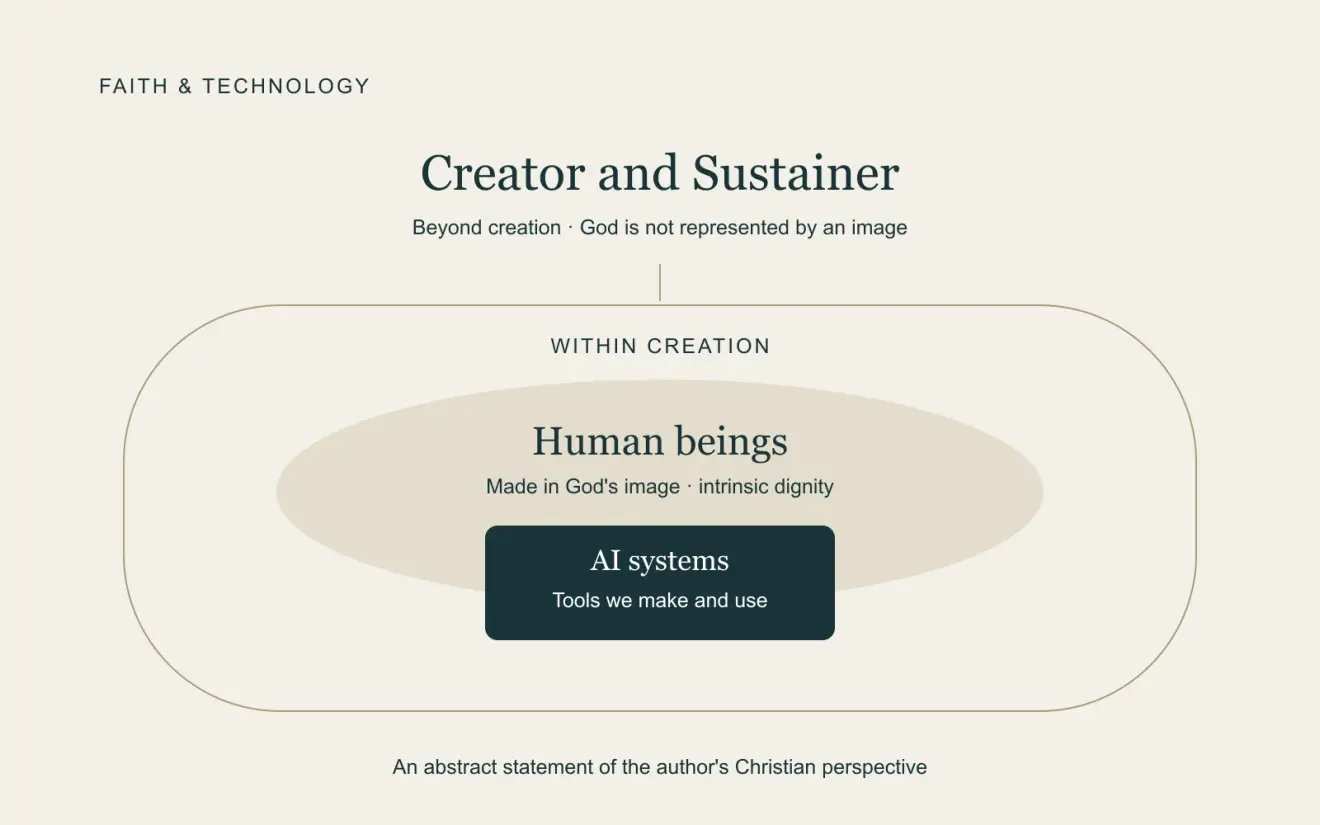
I share his concern about human dignity. My own way of understanding it begins with the distinction between the Creator and His creation. That’s the belief I bring to this discussion, not a claim that the Pope made every theological argument that follows.
What a person is worth
God is the self-existent One. He isn’t a more advanced intelligence somewhere inside the universe, with people and machines a few levels below Him. He is the Creator, beyond time and space, who sustains and remains intimately involved in His creation.
Human beings are creatures made in His image. That gives us value before we accomplish anything. Our worth doesn’t rise when we’re productive or fall when our abilities decline. An employer can’t award it, and an algorithm can’t take it away.
A model may outperform me at a task. It may write code faster or notice a pattern I missed. That doesn’t make it a human person, and it doesn’t diminish my value as one. The trouble comes when we treat performance as the measure of personhood.
Pope Leo warned about the contradiction in calling computational systems intelligent while struggling to recognize human beings’ dignity. Vatican News describes his concern about judging people by their efficiency and productivity. I see that as a problem in how we already regard one another, one that AI can make harder to ignore. If someone’s value depends on how much they produce, a more productive machine will make that person seem worth less.
My Christian understanding of human dignity gives me room to welcome a capable tool without accepting that conclusion. I don’t have to pretend AI is weak to protect what I believe about people. I can take its abilities seriously while refusing to make them the standard for human worth.
How I want to use AI
In practice, I bring a problem to AI early. I let it help investigate the market, examine the code or work through a decision. Then I judge the answer from within a worldview the model didn’t create for me. My theology shapes that judgment, including what I consider worth doing in the first place.
Some of the questions I need to ask aren’t questions of efficiency. Who could be harmed by this decision? What responsibility is still mine even if a system can carry out the task? What does love require of me here? An answer that saves time may still be the wrong answer.
AI can help me think those questions through. It can find arguments I haven’t considered and challenge weak reasoning. But its usefulness doesn’t give it authority to define personhood or moral responsibility. As I’ve argued about AI and human flourishing, we still need to examine what our use of a tool actually does for people.
For me, that examination begins with the conviction that creation belongs to God, people bear His image and our abilities are gifts to steward. Truth doesn’t become true because a group agrees with it or because a model produces a convincing explanation.
That doesn’t settle every decision automatically. Christians who share those convictions can disagree about a product, a policy or an economic tradeoff. We still have to use evidence, listen to the people affected and admit what we don’t know. We should do that prayerfully, with the best tools available to understand the work entrusted to us.
I expect AI to keep changing how I work. I want to learn what it can help me do, and I don’t see a need to hold it at a distance simply because it is powerful. I do need to remain responsible for how I use it. My place is still that of a creature before God, making judgments and caring for people whose worth was never mine to assign.