I want coding agents to keep useful work moving when I am not sitting in front of the machine. An agent that helps for ten minutes while I supervise it is useful. An agent that can safely work through a migration, a test suite, or several bounded tasks while I focus elsewhere creates a different kind of leverage.
Docker’s new Cloud Sandboxes are built around that shift. Docker says developers can start an agent locally, move the environment into cloud-managed compute, close the laptop, and review the result later. Each sandbox runs in an isolated microVM with its own filesystem, network policy, and secrets. Preconfigured kits support coding agents including Codex, Claude Code, Copilot, and others. Docker also says many sandboxes can run in parallel.
What a cloud sandbox provides
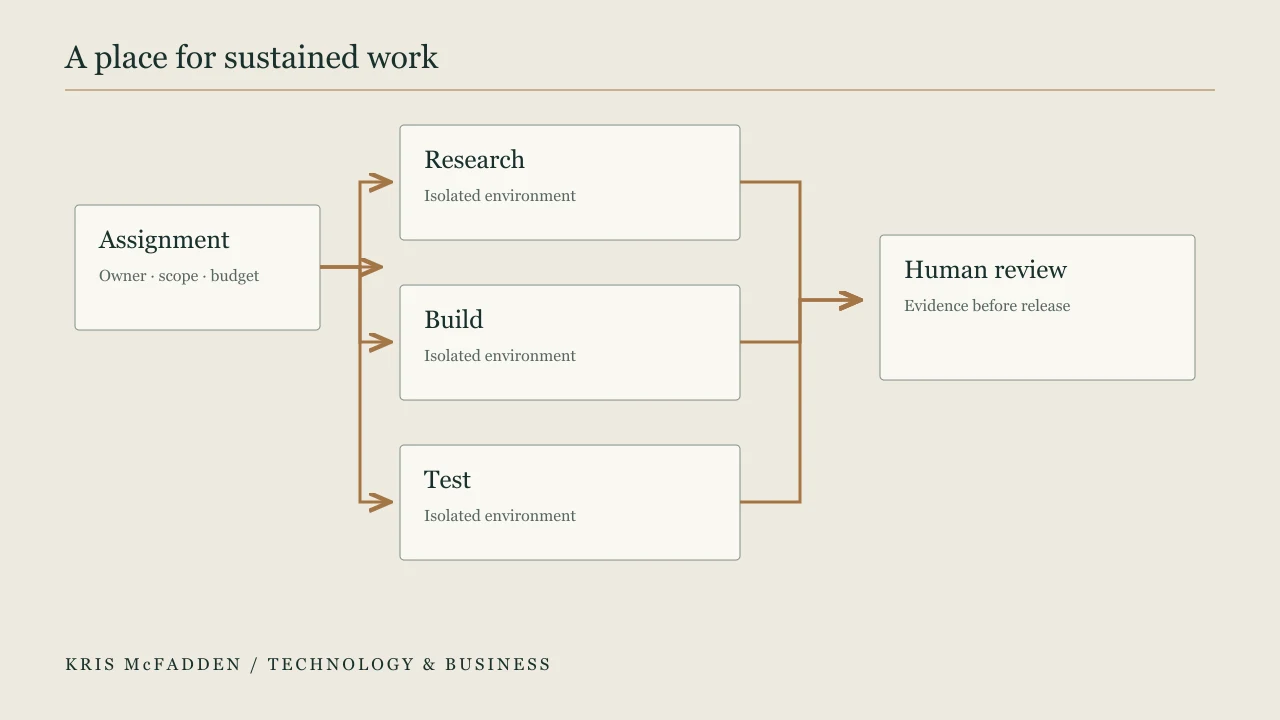
A cloud sandbox is an isolated computing environment where an agent can use tools and keep working independently of a laptop. Its usefulness depends on the agent and the environment working well together.
A capable agent still needs its tools and working files to remain available throughout an assignment. Access must be limited to what the task requires, and the work must leave a record that someone else can inspect. Otherwise a promising run can end with an output that is difficult to trust or continue.
In an agentic workforce, someone must be able to inspect the record of a task and understand what changed. The person responsible for release needs evidence that the result meets the assignment, even if they were away while the work happened.
Docker’s announcement is especially interesting because the infrastructure supports agents that continue working while the human is away. Docker describes sessions lasting as long as 24 hours and shows developers running large numbers of isolated tasks in parallel. Those are Docker’s product claims, not independent proof that every workload becomes reliable or economical.
Where human attention belongs
I would want to begin collaboratively while the task is still being defined, then delegate sustained execution once the assignment is clear. A durable environment makes that separation possible without requiring me to remain present for every intermediate step.
The person responsible for the outcome still needs to handle exceptions and review the result. The infrastructure should make that review easier by preserving what happened while the agent was working.
For a small team, one possible use is to run a research assignment alongside a code change, with each returning evidence for the same review. That only helps when the assignments are sufficiently independent to proceed without creating work for one another.
Set the assignment before adding capacity
Running a hundred agents can also mean paying for duplicated work or letting the same bad assumption spread across several tasks. The operating system still needs to decide which agent owns which task, what evidence it must return, how much it may spend, and when it should stop.
Before leaving an agent running overnight, I would want a bounded assignment, a spending limit, and a result I could inspect the next morning. That is the practical test of whether the extra capacity helps. The judgment required to review AI work remains part of the job.