
AI coding agents can help produce a change, but a product team still has to establish why that change belongs in the product.
Someone must connect the customer evidence to a product decision before an engineer can build and test it. When that reasoning passes through several people, a delay or an incomplete handoff can leave the implementation detached from the original problem.
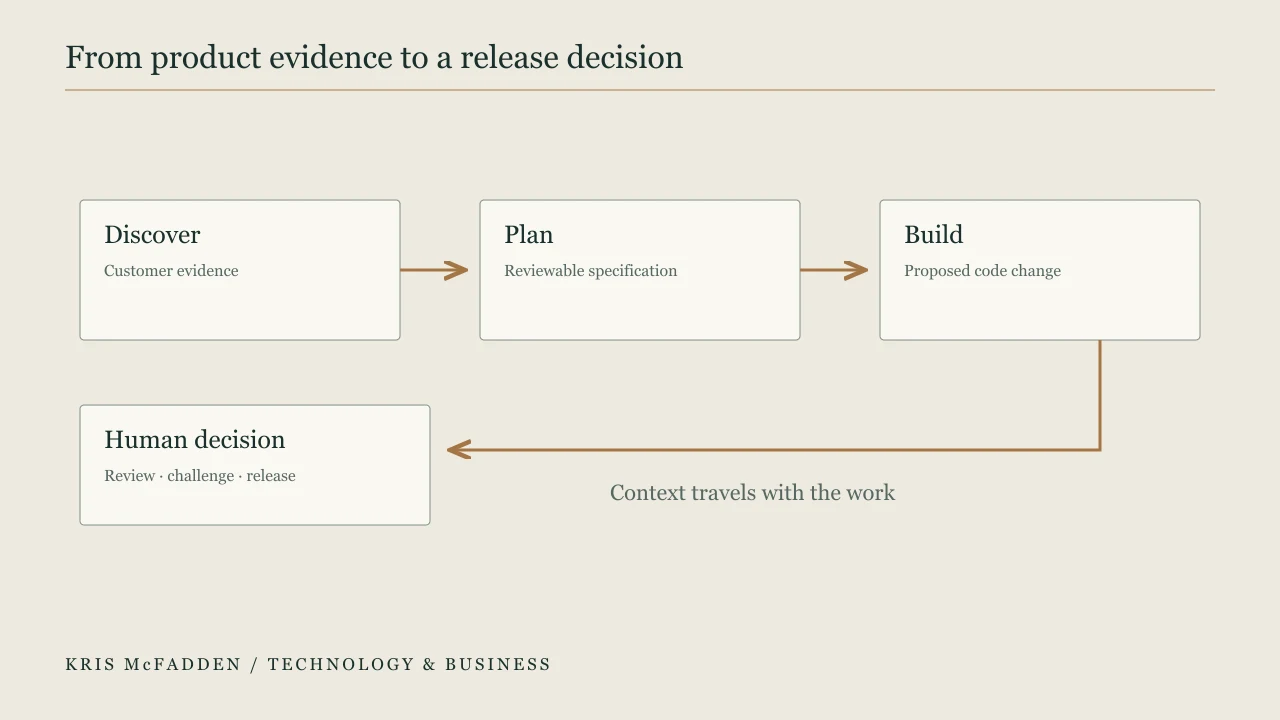
AutonomyAI’s new Discover Mode is an attempt to connect the whole loop. The company says its system can examine product analytics, support tickets, customer calls, and the codebase; identify an improvement; produce an evidence-backed brief; turn that into a plan; generate the change; and open a review-ready pull request. Engineers remain the merge gate.
Carrying evidence into a product decision
AI product development uses AI tools across the work of deciding, building, and evaluating product changes. I am interested in how focused capabilities can preserve the context as that work moves between roles.
In the workflow AutonomyAI describes, discovery produces evidence that planning can map to the existing codebase. Building follows that plan and includes visual checks before an engineer reviews the proposed change. The human team retains the decision about what reaches production.
For a founder or lean product team, the appeal is help with work that might otherwise wait for someone to become available. That structure resembles how a team divides responsibility, though the quality of the handoffs still needs to be tested.
If the system works as described, a product manager could spend less time collecting signals manually. An engineer might then receive a proposed change with enough supporting context to understand why it was requested. Those are useful possibilities to test against the team’s existing process.
Those are AutonomyAI’s promised capabilities. The company also says more than 170 teams use its platform and names several recognizable customers. These are company-reported claims and do not establish how consistently the system produces good product decisions or safe code across different environments.
Deciding which problem deserves work
AI can find patterns in support data, but leadership still decides which customers and outcomes matter. It can recommend a feature, but not every repeated request belongs in the product. It can generate code consistent with existing patterns, but existing patterns may contain technical debt or a bad assumption.
I would give each agent a bounded assignment with an explicit acceptance test. A discovery brief should explain the evidence and its limits, and a plan should surface assumptions before implementation begins. Reviewers need enough independence to challenge the resulting code rather than simply confirm that the requested change was made.
Clear roles may help a small team take on more work, but the announcement does not establish how much faster a particular team will ship.
What I would check in a trial
A useful handoff carries the reason for the work along with the task. I would check whether the proposed change still answers the customer evidence that started it and whether an engineer can review it without rebuilding the whole argument.
The benefit would be time returned to deciding what deserves to exist. As with AI work in engineering, the evaluation has to include the effort required to verify the output. A shorter path to a pull request is useful only when the team can make a sound release decision.